
Shark Guide
Our shark guide helps you understand the different animals we go to see, so you can choose your holiday with more than a picture of a fin in mind.
If you tell me you want to see sharks, I want to know which ones interest you, because a reef shark, a thresher and a whale shark offer very different experiences. Their food, movement and breeding all differ, and learning about those differences is part of the enjoyment.
Our shark diving page covers the experience. Separate guides explore bull sharks, thresher sharks and whale sharks in more depth.
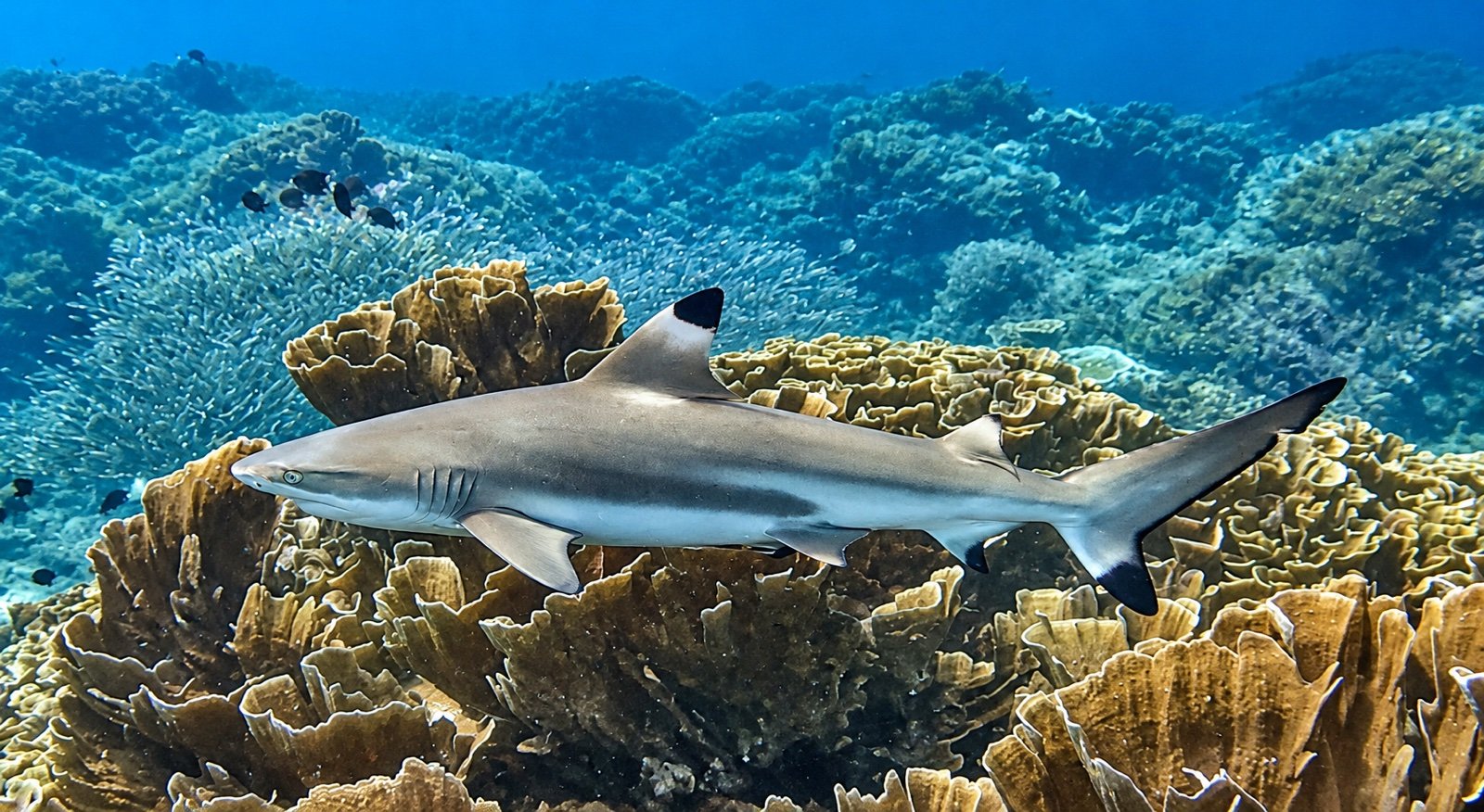
Shark guide: names and natural history
A guide to reef shark names
Blacktip reef sharks, Carcharhinus melanopterus, have conspicuous dark fin tips. In contrast, whitetip reef sharks, Triaenodon obesus, have pale tips and a more slender shape. However, colour alone can mislead in poor light.
Grey reef sharks are Carcharhinus amblyrhynchos. So, we look at fin shape, markings and the whole body rather than guessing from one feature.
Ancient relatives, living diversity
Sharks belong to a lineage with a very long fossil history. However, today’s species have continued to evolve; ancient ancestry does not mean they are unchanged relics.
In addition to their shared ancestry, their skeletons are mainly cartilage. The name Triaenodon, referring to three-pointed teeth, also reminds us that teeth can reveal more than the silhouette visible on a dive.
- Animal group
- Cartilaginous fishes
- Blacktip reef shark
- Carcharhinus melanopterus
- Whitetip reef shark
- Triaenodon obesus
- Grey reef shark
- Carcharhinus amblyrhynchos
- Breathing
- Gills
- Reproduction
- Varies by species
Your guide to seeing sharks with us
Our shark experiences include Egypt’s Red Sea, with Marsa Alam relevant to our southern diving plans. Explore the Egypt shark diving holiday for the actual trip and our Egypt destination page for the wider setting.
Other holidays focus on different sharks, including bull sharks in Mexico, threshers in the Philippines and whale sharks in Borneo. So, choosing the animal also means choosing an appropriate destination and experience.
A guide to shark growth and lifespan
Why there is no single shark lifespan
There is no single age, size or growth rate that describes every shark. A small reef species and an enormous whale shark live very different lives. So we need to know which animal we are talking about before putting numbers to it.
Many sharks take years to mature and produce relatively few young. That is why an apparently busy dive site does not tell us that a population can easily replace its adults. We want you to understand the life behind the encounter, as well as enjoy seeing the animal.
Growing in different habitats
Young sharks may use nursery habitat that differs from the places adults visit. For example, shallow coastal areas can be especially important for some species.
However, a small shark is not necessarily a baby of the largest shark nearby. Instead, it may be an adult of a smaller species, which is another reason careful identification matters.
Shark guide to eggs, pregnancy and pups
How do sharks reproduce?
Fertilisation is internal. Specifically, a male uses a clasper to transfer sperm to the female. After fertilisation, development depends on the species: some lay egg cases, while others give birth to live pups.
We should therefore ask which shark we mean before answering whether sharks lay eggs.
Live-bearing reef shark examples
Blacktip, grey and whitetip reef sharks give birth to live young, with developing pups nourished through a yolk-sac placental connection. However, live birth does not always involve a placenta: whale shark embryos develop differently.
So, these reef sharks do not lay egg cases on the seabed. Because their pregnancy lengths and litter sizes differ, we do not borrow figures from one for another.
Shark feeding guide
Watch how different sharks find their food. Many reef sharks eat fish, squid or crustaceans. A whitetip reef shark can search inside reef crevices, especially at night, while a whale shark filters tiny food from the water. A thresher uses its long tail as part of the hunt.
Sharks also use several senses together. Smell, hearing, sight and sensitivity to movement help them understand their surroundings. Also, at close range they can detect weak electrical fields. It is far more interesting than reducing everything to one extraordinary sense.
We explain the particular encounter before you get in. Then follow the guide and watch what the shark is doing. I want you to come away with a better understanding of the animal, alongside the excitement of having seen it.
A guide to shark movement and rest
Not every shark has to keep swimming. Whitetip reef sharks can rest on the seabed while moving water over their gills. Other species depend more on moving forward to keep water flowing through. So a resting shark is not automatically in trouble.
A group of sharks also needs a little interpretation. Food, currents, shelter or breeding may bring them together; seeing several animals does not mean they are acting as a hunting pack.
When we are in the water, we keep our movements controlled and leave their routes clear. Let the guide help you find your position. Chasing a shark can disturb the animal and bring everyone’s encounter to an early end.

Shark conservation guide
Different species need different protection
Fishing, accidental capture and habitat damage affect many sharks. Because growth is slow and reproductive output low in many species, losses can be difficult to replace. However, the level of risk differs among species and populations.
So, we avoid treating all sharks as either invulnerable predators or identical conservation cases. Also, protecting nursery areas and healthy food webs matters alongside responsible viewing.
Our preparation and local knowledge
I have spent seven years on the wider firsthand research behind Dive UK Travel. Over the past three to three-and-a-half years, we have also returned regularly to our destinations, often spending a month exploring and diving with local people.
Our guides bring years of daily experience in these waters. That helps us match the shark experience to the place and to your diving, rather than treating every encounter alike. You can read more about our research.
Shark Guide: your questions
Are all sharks dangerous to divers?
No, but it is important to understand which shark we are talking about and the conditions of the encounter. Species differ in their size, diet and behaviour, so we do not treat every shark dive in the same way. Before you book, we talk through your experience and confidence in the water to help you choose a suitable trip. Then our briefing explains where to position yourself, how to move and what to do during that particular encounter. I want you to feel properly prepared and able to enjoy watching the animals. Sharks are wild, so we give them space and follow the local guide’s instructions.
Do sharks lay eggs?
Some sharks lay eggs, while others give birth to live young. Fertilisation takes place inside the female, but what happens next depends on the species. Egg-laying sharks leave their young developing inside protective egg cases. In contrast, blacktip, grey and whitetip reef sharks give birth to live pups, with nourishment supplied through a yolk-sac placental connection during development. However, live birth does not work in exactly the same way for every shark: whale sharks develop inside eggs within the mother before being born. So, when we discuss breeding on a trip, we explain the species we are looking at rather than giving one answer for all sharks.
Must every shark keep swimming?
No. Sharks need water to pass over their gills to obtain oxygen, but they do not all move that water in the same way. A whitetip reef shark can keep water flowing over its gills while resting on the seabed. Other species rely more on forward movement to maintain that flow. Therefore, seeing a shark lying still does not automatically mean that something is wrong. If we find one resting, we give it room and watch quietly. There is no need to make it move for a photograph; observing how it rests is part of understanding the animal.
Is a whale shark a whale?
No. A whale shark is a fish, and it belongs to the shark group. It takes oxygen from the water through its gills, whereas a whale is a mammal that breathes air at the surface. Its enormous size explains the whale part of the name. Also, unlike many of the reef sharks in this guide, it feeds by filtering small food from the water rather than pursuing larger prey. We see whale sharks on our Borneo trips, and understanding how they feed helps you appreciate what is happening during the encounter. Our separate whale shark guide explains their biology in more detail.
Which shark holiday should we choose?
Start by telling me which sharks you would most love to see, then tell me about your diving experience and what you enjoy underwater. Egypt’s Red Sea, bull sharks in Mexico, threshers in the Philippines and whale sharks in Borneo offer very different holidays. The animal matters, but so do the dive conditions, your confidence and the other experiences you want from the trip. We use our destination knowledge and local relationships to talk you through those differences and help you choose. Before you commit, we explain the relevant requirements and how the shark experience fits into the holiday. Sightings involve wild animals, so we plan carefully without promising a particular encounter.
Come and discover sharks with us
Tell me which sharks you would love to see and what diving you have done. We can talk through our Egypt shark holiday and the different experiences in Mexico, the Philippines and Borneo, then work out what suits you.
We put time into the places and people behind these holidays. Come and share that with us, and enjoy learning about the animals as well as getting into the water with them.
Have you got four friends who would love to dive with sharks? Get together and speak to me, and we can plan a Shark Week specifically for you. Tell me which sharks you would like to see and about everyone’s diving experience. Then we can talk through the destination and put a trip together for your group.
Explore our Egypt shark diving holiday