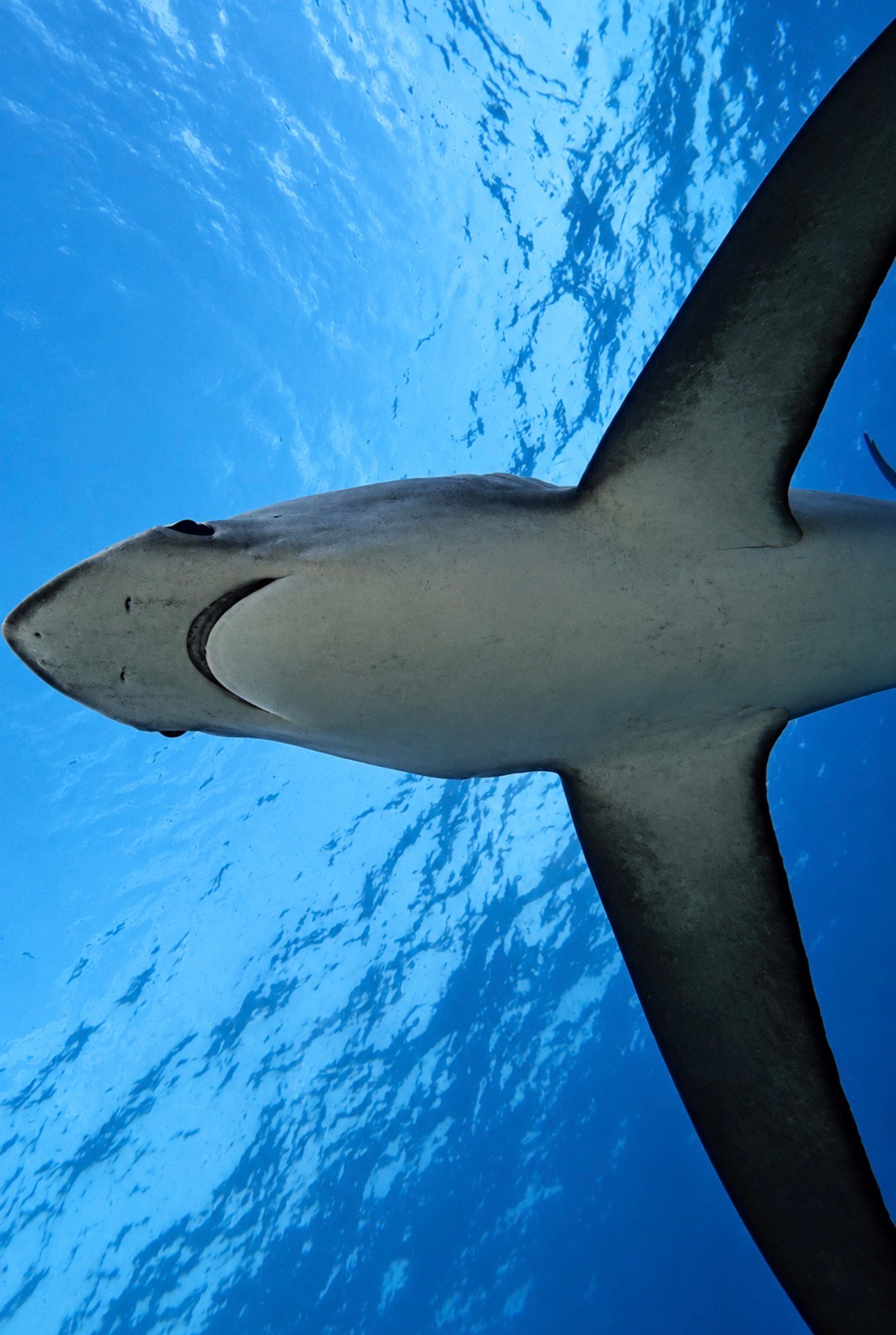
Thresher Shark Guide
Our thresher shark guide takes a closer look at the sharks we go to see in the Philippines, from that incredible tail to how they feed, mate and give birth.
Seeing one come out of the blue is something very special. But once you understand a little more about the animal, you start noticing things you might otherwise miss. Why is it circling? What are those little fish doing? And why does it have such a long tail?
Here we focus on the pelagic thresher shark, the species we look for around Malapascua. If you are ready to see them yourself, have a look at our diving with thresher sharks page.
Thresher shark guide: names and history
What does the Latin name mean?
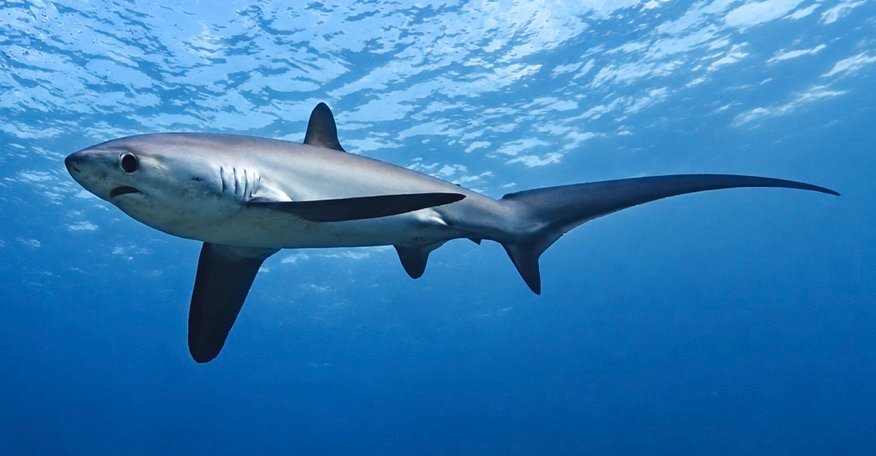
The scientific name of the pelagic thresher shark is Alopias pelagicus. Although we often call these Latin names, both parts have Greek roots. Alopias comes from the word for fox, while pelagicus refers to the open sea.
The long tail also explains names such as fox shark and foxtail. “Thresher” describes the way the shark uses its tail to strike its food.
Three different thresher sharks
Hiroshi Nakamura described the pelagic thresher in 1935. It belongs to the family Alopiidae, alongside the common thresher, Alopias vulpinus, and the bigeye thresher, Alopias superciliosus.
They all have that striking tail, but they are separate species. Their size, range and reproductive details are not all the same. The facts below are about the pelagic thresher.
- Scientific name
- Alopias pelagicus
- Family
- Alopiidae
- Typical length
- Around 3 metres, including the tail
- Food
- Fish and squid
- Reproduction
- Live young, usually two pups
- Where we go
- Malapascua, Philippines
Your guide to finding thresher sharks
For us, Malapascua in the Philippines is the place to go. The nearby offshore shoals give divers the chance to see pelagic threshers visiting cleaning stations. It is one of the reasons we include this part of the Philippines in our holidays.
These sharks live much more widely across the Indian and Pacific oceans. They spend much of their lives in open water, so knowing they occur in a country is very different from knowing where you have a good chance of seeing one.
Our Malapascua page explains the location. For the dives themselves, including our early starts, private guides and experience requirements, read about diving with thresher sharks. You can then explore our Philippines diving holiday to see how the trip fits together.
A guide to the thresher shark lifecycle
How a thresher shark grows from pup to adult
A pelagic thresher starts life as a fully formed, free-swimming pup. Its long tail is already there at birth. It then takes years to grow into an adult capable of breeding.
Maturity varies between populations. In Indonesian waters, estimates put males at about ten years and females at about thirteen. These are useful guides to how slowly they develop, rather than a fixed birthday for every shark.
How long do thresher sharks live?
Pelagic threshers can live for decades. Estimates for females reach roughly 28 to 30 years, but their exact maximum lifespan is still uncertain.
That slow development matters. A shark can spend many years growing before it produces any young. With such small litters, lost adults cannot quickly be replaced.
Thresher shark guide to mating and pregnancy
How do thresher sharks mate?
Like other sharks, threshers fertilise their eggs inside the female. Males have a pair of organs called claspers beside their pelvic fins. During mating, a male uses one clasper to transfer sperm.
The young then develop inside the mother. Pelagic threshers give birth to live pups; they do not lay egg cases on the reef.
Thresher shark pregnancy and developing pups
Pregnancy appears to last around a year. Estimates from the eastern Pacific are about 11–12 months, although we should not assume exactly the same timing in every population.
At first, the embryos use their yolk supply. Later, they feed on unfertilised eggs produced by the mother. This is called oophagy, meaning egg eating. Usually two pups are born, although litter size can vary. Eating these eggs is not the same as eating their siblings.
Thresher shark feeding guide
Pelagic threshers eat fish and squid. Their menu depends on what is available where they live. Schooling fish such as sardines can make a good meal, while squid are particularly important in some areas.
How does that long tail catch food?
That tail is far more than something impressive to photograph. The shark can sweep it over its body and strike a shoal of fish. A powerful tail slap stuns or kills prey, making it easier to collect and eat.
One strike can catch more than one fish. After the slap, the shark turns back to pick up its meal. It is a very different hunting method from simply rushing in and biting a fish.
A guide to thresher shark behaviour
When a thresher circles slowly over a cleaning station, it is not necessarily looking for food. Small cleaner fish approach and remove parasites from its skin. The shark slows down and changes its swimming pattern to let them work.
That is something to watch for on a dive. Instead of concentrating only on getting a picture, look at the little fish around the shark and how it moves past them.
Do thresher sharks migrate?
Pelagic threshers move through open water and can travel over wide areas. However, their movements are not fully mapped. Returning to a cleaning station does not mean a shark spends its whole life beside that reef, or follows a route we can predict every day.

Thresher shark conservation guide
The pelagic thresher is classed as Endangered globally. Fishing pressure, including accidental capture, is a serious problem for a shark that takes years to mature and produces so few young.
Seeing sharks regularly at one dive site does not tell us that the whole population is doing well. Protecting the animals and the places they use both matter.
What we learn by being there
We return to our destinations regularly, spending time in the water and learning from the people who dive there every day. Some of the local guides we work with have thousands of dives in these waters. Their knowledge has been a huge part of our own learning.
That helps us plan the holidays and explain what you are watching. We keep learning on every visit, and we share that knowledge with you before and during the trip. You can read more about our destination research.
Thresher shark guide: your questions
Are all thresher sharks the same species?
No. There are three living species: pelagic, common and bigeye threshers. This guide focuses on the pelagic thresher, which we go to see around Malapascua.
Do thresher sharks lay eggs?
No. Thresher sharks give birth to live young. Pelagic thresher pups develop inside the mother and feed on unfertilised eggs during pregnancy.
Why is a thresher shark’s tail so long?
It is a hunting tool. The shark uses its long upper tail lobe to strike fish, stunning or killing them before turning back to eat them.
Why do they visit cleaning stations?
Cleaner fish remove parasites from their skin. A shark may circle slowly through the area while the fish work. Keeping its route clear helps it carry on with that behaviour.
Can we come and see thresher sharks with you?
Yes. Malapascua is part of our Philippines diving holiday. Our thresher shark diving page explains what to expect and the experience you need. We plan carefully with our local guides, while remembering these are wild animals.
Come and see thresher sharks with us
Reading about them is one thing. Watching that long tail glide past you in the blue is something else entirely. Come and join us in the Philippines and see these great animals for yourself.
We bring together the places we know, the guides we trust and the planning that makes a holiday work. Have a look at the trip, then speak with us about joining.
Join our Philippines diving holiday