Dugong Guide
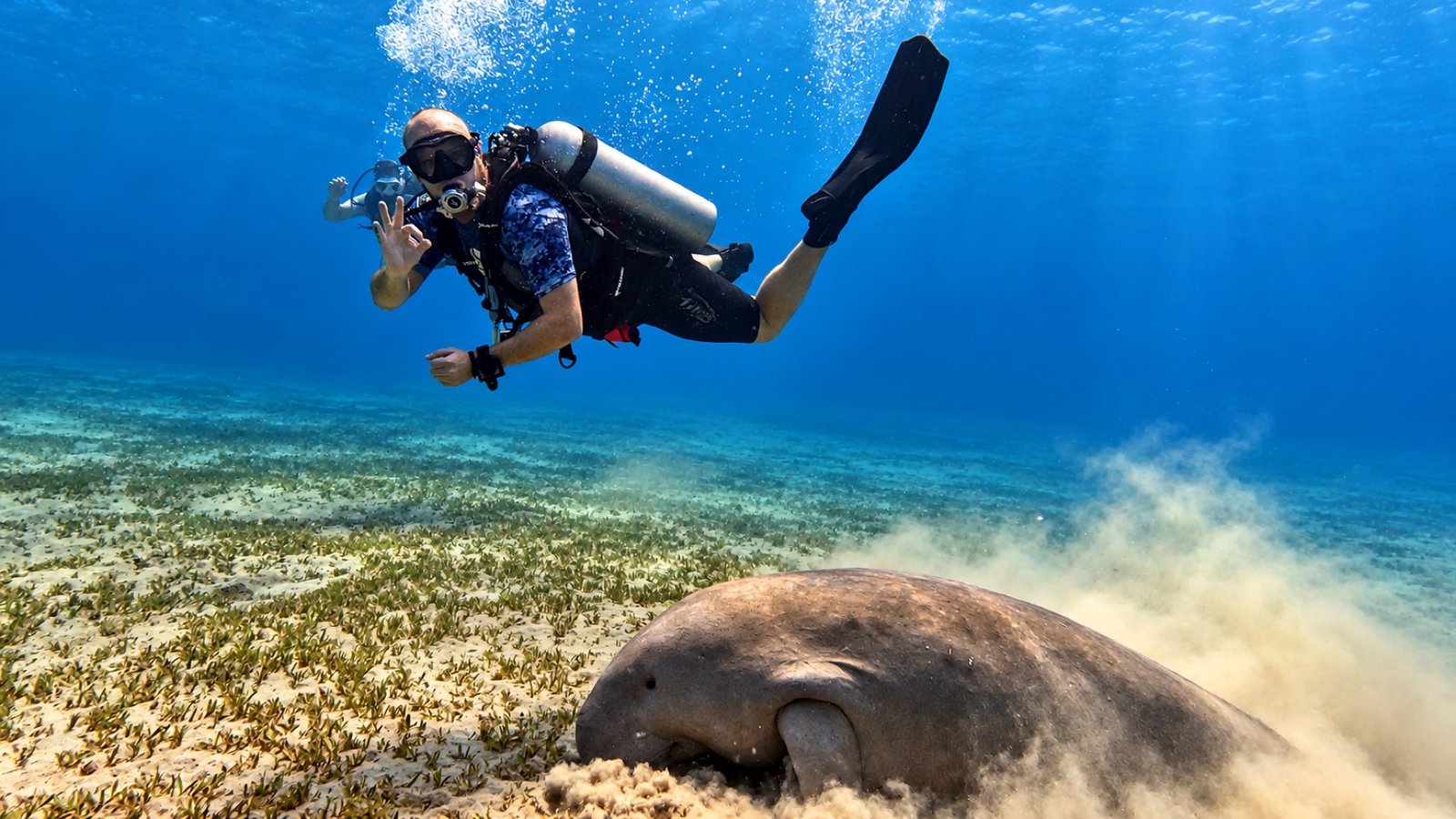
We’ve been seeing dugongs in Egypt for the last seven years. In this dugong guide, I want to share what we know about them and explain where you can see them with us.
We can also see dugongs during our snorkelling trip in Alor. However, we cannot get in the water with them there. The experience is different from Egypt, so we explain that when we talk about your holiday.
If seeing a dugong is something you would like to do, have a look at our dugong encounter page. Below, we explain a bit more about the animal, what it eats and how it lives.
Dugong guide: names and natural history
What is a dugong?
The scientific name is Dugong dugon. The name comes from Malay and related regional words for the animal, rather than from Latin alone. Dugongs belong to the order Sirenia, which also includes manatees. However, the nickname sea cow does not mean they are cattle living in the ocean.
Surprisingly, their evolutionary relatives include elephants. That is a relationship revealed by ancestry, rather than a claim that an elephant recently became a dugong.
A guide to recognising a dugong
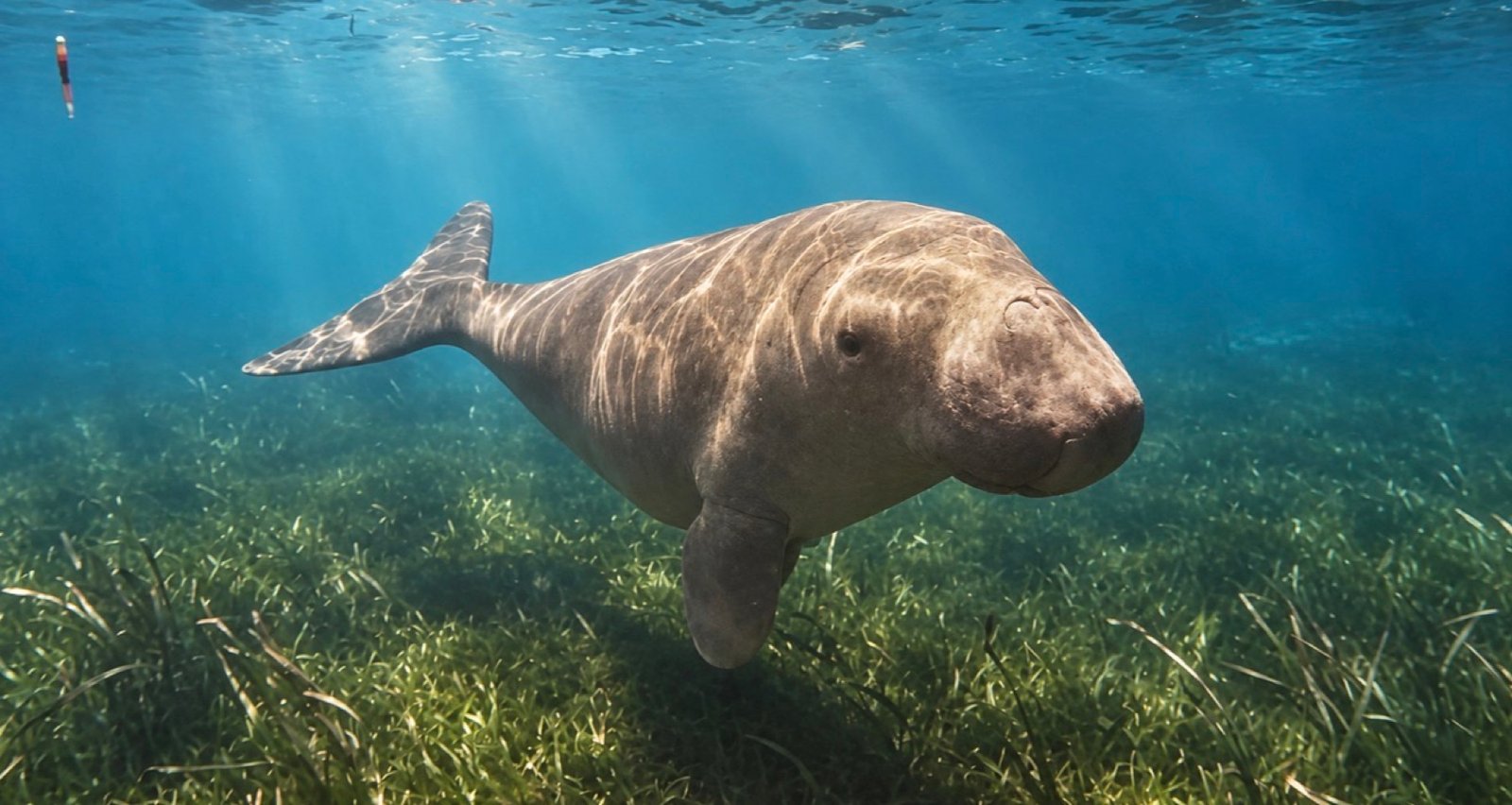
Look for a downward-facing muzzle, rounded body and a tail divided into two flukes. Unlike a dolphin, a dugong has no dorsal fin. In contrast, a manatee has a paddle-shaped tail.
Also, the dugong is the only living member of its family. Its relative Steller’s sea cow disappeared in the eighteenth century, a reminder that large marine herbivores are not immune to extinction.
- Scientific name
- Dugong dugon
- Animal group
- Marine mammal
- Main food
- Seagrass
- Tail
- Two flukes
- Young
- Usually one calf
- Where we go
- Marsa Alam, Egypt, and Alor
Your guide to seeing dugongs in Egypt and Alor
In Egypt, we look for dugongs around Marsa Alam. Because they feed on seagrass, we work with local people to understand where they have been and how they are moving between feeding areas.
Our Marsa Alam dugong experience explains the outing. You can also read about diving in Egypt and our Egypt holiday.
We can also see dugongs on our snorkelling trip in Alor. However, we cannot enter the water with the dugongs there. Although the day includes snorkelling, the dugong part of the trip is viewing only.
A guide to dugong growth and lifespan
A long life with slow development
A dugong may live for many decades. Ages around 70 years have been recorded, although that is a long-lived individual rather than an average for every animal.
Growing up also takes time. Maturity varies with sex, habitat and the food available, and a female may take many years to produce her first calf. So the adult we hope to watch is part of a much longer story than our time in the water.
Why healthy seagrass matters
A young dugong develops from a milk-dependent calf into a seagrass feeder. So, it needs habitat that can support growth as well as survival.
Because dugongs reproduce slowly, losing adults or damaging feeding grounds can have consequences that last much longer than a single season. As a result, recovery takes time.
Dugong guide to pregnancy and calves
How do dugongs reproduce?
As mammals, dugongs mate in the water and develop their young inside the mother. Pregnancy lasts roughly thirteen to fifteen months. After that long pregnancy, usually one calf is born.
After birth, the calf must breathe at the surface and drinks milk from its mother. Unlike a shark pup, however, it is not born able to live independently.
A long investment in one calf
Nursing can continue for around fourteen to eighteen months, and births are often several years apart. Because reproduction demands energy, food availability influences the female’s ability to breed.
So, seeing a mother and calf is a reason for extra patience. So, we never position ourselves between them or obstruct their route to the surface.
Dugong feeding guide
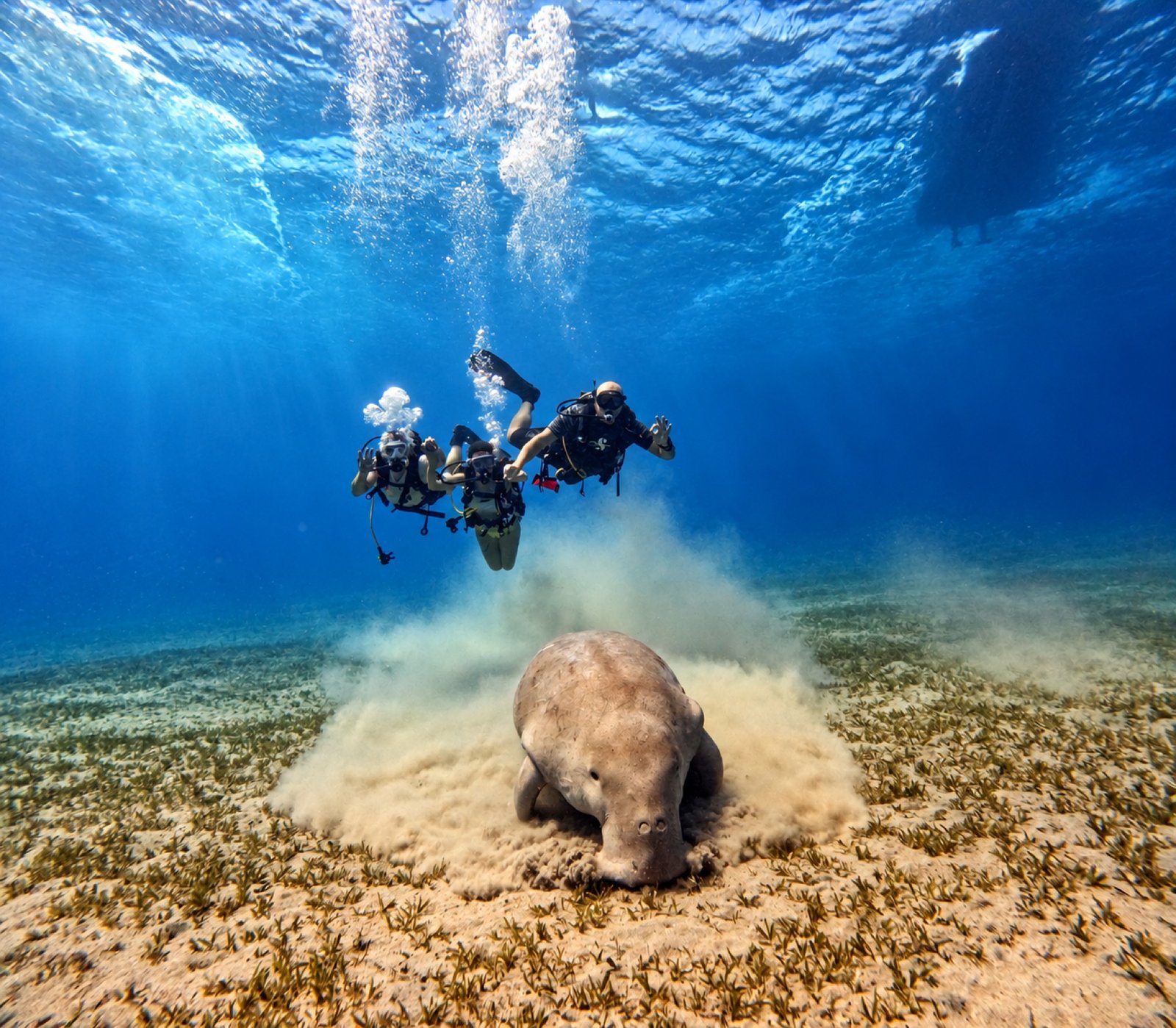
Because seagrass is the dugong’s main food, we look for suitable meadows when we search. It is a flowering plant growing underwater, rather than seaweed. To gather that food, the dugong uses its sensitive muzzle and muscular upper lip to gather the plants from the bottom.
As it feeds, it can leave trails where plants have been cropped or uprooted. However, a bare patch alone does not tell us a dugong has just been there. We draw on the local team’s knowledge as well as what we can see.
When we are in the water in Egypt and find one feeding, the meadow needs care too. Keep your fins and equipment clear of the plants, and avoid stirring up the bottom. We want you to enjoy watching the dugong carry on with its meal.
A guide to dugong movement and breathing
A dugong needs to breathe at the surface, even when it seems completely absorbed in feeding. Afterwards, it returns underwater to continue. That simple part of its day shapes how we watch it.
In Egypt, when we are in the water, we leave a clear route above and around the animal. Then our guide helps us choose a position, so we can observe without following closely behind it towards the surface. If a mother and calf are together, we also keep out of the space between them.
Dugongs move between feeding areas, so a familiar animal may be further along the coast when we arrive. As a result, local knowledge helps us search sensibly. However, it cannot turn a wild animal into an appointment, and I want you to understand that before we go.
Dugong conservation guide
Protecting the animal and its food
Damage to seagrass, entanglement in fishing gear and vessel collisions can threaten dugongs. Also, coastal water quality affects the habitat they depend on.
So, our viewing keeps a respectful distance: we do not touch, chase or feed a dugong. Likewise, we do not kneel on seagrass or coral. A photograph is never a reason to interrupt feeding or block a breath.
Why we spend time with local people
We’ve been seeing dugongs in Egypt for the last seven years, and our success rate is around 50% — about 50–50. So, although we know the area and put the work in, we do not see one every time.
We work with local people down near the dugongs because they are there every day. They help us understand the animals’ movements and where they have been feeding. That daily knowledge is why we keep in touch with them when we plan a trip. You can read more about our research approach.
Dugong Guide: your questions
Is a dugong a manatee?
No. Although they are related marine mammals, a dugong has a fluked tail while a manatee has a paddle-shaped tail.
Can a dugong breathe underwater?
No. It breathes air and must return to the surface, so we always keep its route clear.
What do dugongs eat?
Their main food is seagrass. Protecting these underwater flowering plants is essential to protecting dugongs.
Do dugongs lay eggs?
No. They give birth to live calves and nurse them with milk, usually raising one calf at a time.
Can we plan a dugong experience with you?
Yes. Read about our Marsa Alam experience and speak with us about your holiday. We can also see dugongs during the Alor snorkelling trip, but we cannot enter the water with them there.
Come and see dugongs with us
If you would like to see a dugong, let me know when we talk about your holiday. We can explain the Egypt experience and how dugong viewing fits into the snorkelling trip in Alor. Remember, we cannot get in the water with them in Alor.
Tell us what you would like to do, and we will talk you through the options. Although we work with people who know the area, these are wild animals, so we cannot promise a sighting.
Explore our Egypt diving holiday